
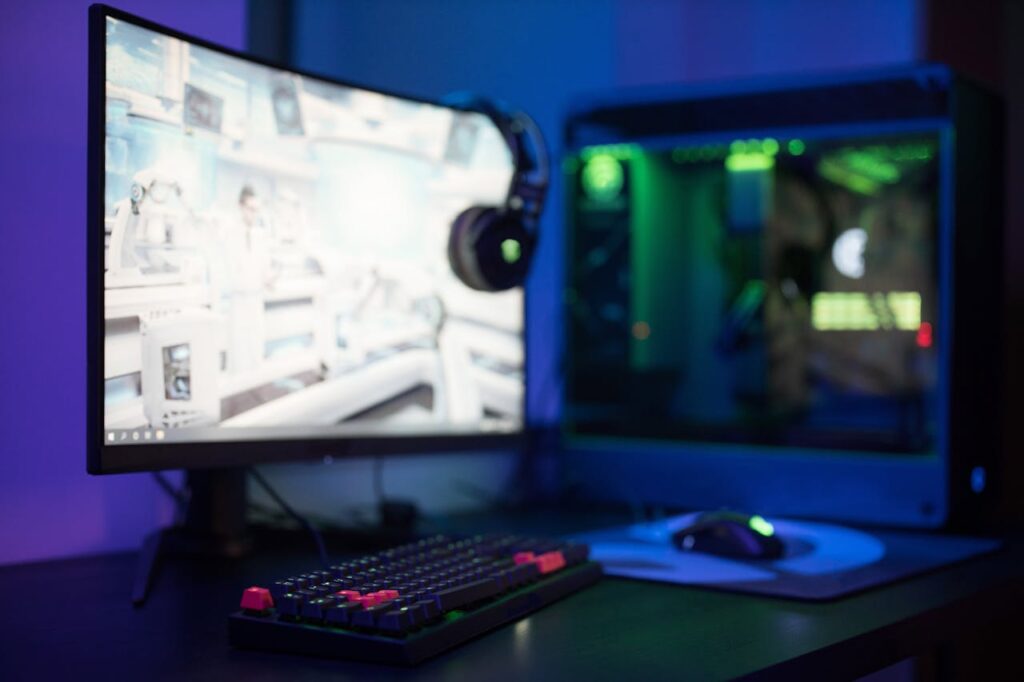
Choosing the right gaming PC specifications in 2026 is more important than ever due to increasing hardware demands, larger game sizes, ray tracing technology, AI upscaling, and higher performance expectations from modern games. Many people overspend on unnecessary components while others create unbalanced systems that limit gaming performance. Understanding what specifications actually matter helps gamers build a gaming PC that delivers strong FPS, upgradeability, and value for money.
The graphics card remains the single most important component in any gaming PC build. In modern games, the GPU has the largest impact on frame rates, graphical quality, ray tracing performance, and overall gaming experience. In 2026, the NVIDIA RTX 50 series and AMD RX 8000/9000 series dominate the gaming GPU market, offering stronger performance and improved AI-assisted technologies compared to previous generations.
For 1080p gaming, graphics cards such as the RTX 4060, RTX 5050, RX 7600, and RTX 5060 are capable of delivering excellent high refresh rate gaming performance. Competitive games such as Fortnite, Valorant, Counter-Strike 2, and Apex Legends can easily exceed 144 FPS on these GPUs. For gamers targeting 1440p gaming at high settings, GPUs such as the RTX 5070, RTX 5060 Ti, RX 7800 XT, and RX 8800 XT provide a stronger balance between performance and future-proofing.
VRAM has become increasingly important in 2026. While 8GB graphics cards are still usable for 1080p gaming, many modern AAA titles are beginning to exceed 8GB VRAM usage at ultra settings and higher resolutions. Many builders and hardware reviewers now recommend aiming for at least 12GB VRAM for stronger long-term performance and future-proofing.
The CPU is the second most important gaming component. Although the graphics card affects gaming performance more heavily, the processor still impacts minimum FPS, system responsiveness, multitasking, streaming, and overall smoothness. In 2026, AMD’s AM5 platform continues to dominate gaming recommendations due to its upgrade path and strong gaming efficiency. Ryzen processors such as the Ryzen 5 7600, Ryzen 7 9700X, Ryzen 7 9800X3D, and Ryzen 5 7600X3D are among the strongest gaming CPU options currently available.
Intel processors still remain competitive, especially for productivity and multitasking workloads, but many gamers favour AMD AM5 systems due to their longer-term motherboard support and upgrade flexibility. Modern gaming PCs should generally use at least a 6-core 12-thread processor to ensure smooth performance in current and upcoming games.
RAM requirements have changed significantly in recent years. While 16GB RAM remains usable for pure gaming, 32GB DDR5 RAM is increasingly becoming the recommended standard for modern gaming PCs, especially for users who multitask, stream, use Discord, keep browser tabs open, or play demanding AAA games. Microsoft itself recently suggested that 32GB is becoming the “future-proof” gaming configuration while 16GB is now considered more of a starting point.
DDR5 memory is now the preferred option for all new gaming PC builds. DDR4 still exists in older budget systems, but DDR5 offers improved speeds, better platform longevity, and compatibility with newer CPUs and motherboards. For AMD AM5 gaming systems, DDR5-6000 is often considered the performance sweet spot.
Storage is another major factor when building a gaming PC in 2026. Traditional hard drives are rapidly becoming obsolete for gaming systems due to modern technologies such as DirectStorage and increasing game loading demands. NVMe SSDs are now essential for fast boot times, rapid game loading, and general system responsiveness. Most gaming PCs should use at least a 1TB NVMe Gen 4 SSD, while 2TB storage is increasingly recommended due to modern games often exceeding 100GB per installation.
Motherboard selection should focus on compatibility, upgrade path, and reliability rather than expensive unnecessary features. For AMD gaming PCs, B650 motherboards remain one of the best overall choices due to DDR5 support, PCIe Gen 4 or Gen 5 support, and future Ryzen compatibility. Expensive enthusiast motherboards rarely improve gaming FPS significantly and are often unnecessary for most gamers.
Power supplies are often overlooked but remain one of the most important components for long-term system stability and safety. Cheap low-quality power supplies can cause instability, hardware damage, or system failure. Most mid-range gaming PCs in 2026 should use at least a reliable 650W to 850W 80+ Bronze or Gold certified PSU depending on the graphics card being used.
Cooling and airflow also play a major role in gaming PC performance. Cases with poor airflow can cause high temperatures, thermal throttling, and reduced component lifespan. Mesh-front airflow cases with multiple intake fans are strongly recommended for modern gaming builds.
For gamers building a balanced gaming PC in 2026, the most important strategy is maintaining proper component balance. Overspending on a high-end CPU while pairing it with a weak GPU creates poor gaming value. Most gaming-focused builds should prioritise GPU investment first, followed by CPU, RAM, and storage. Some builders follow the general rule of allocating around half the total budget towards the graphics card for the best gaming performance results.
Ultimately, the best gaming PC specifications depend on your target resolution, desired FPS, game preferences, and overall budget. Competitive gamers may prioritise high refresh rates and CPU responsiveness, while AAA gamers may focus more heavily on GPU power, VRAM, and visual quality settings.
If you are unsure which gaming PC specifications are right for your build, PC Build Experts can help recommend the best combination of CPU, GPU, RAM, storage, and cooling based on your budget and gaming goals. Building a properly balanced gaming PC ensures maximum performance, future upgradeability, and long-term value without wasting money on unnecessary components.